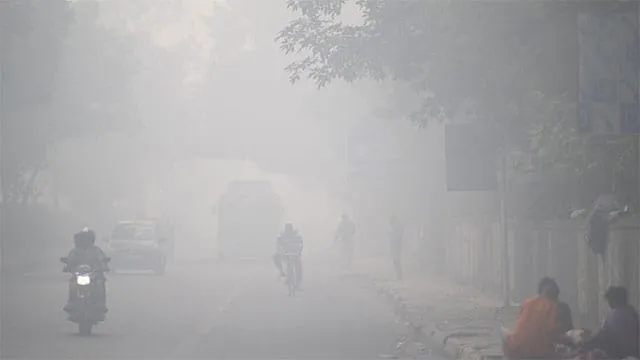
Millions marked the Hindu festival of lights with fireworks across India's capital, intensifying winter smog already driven by traffic, factories and farm fires.
The Supreme Court had allowed limited use of green firecrackers with lower emissions this month, but explosions echoed across the city as rules were flouted.
Dangerous Readings
About eight hours after fireworks peaked, cancer-causing PM 2.5 microparticles reached 879 micrograms per cubic metre in the Mandir Marg area early Monday, monitoring organisation IQAir said, citing city government data.
That reading is almost 59 times the daily maximum suggested by the WHO. Officials had already put limits on traffic and construction to control smog across New Delhi, a metropolis of over 30 million people.
Sources of Smog
India's environment ministry reports vehicles generate 23 percent of winter pollution in Delhi, while biomass burning like farm stubble fires brings 20 percent.
Industry, including coal-fired power plants, adds roughly nine percent. The biggest portion, 27 percent, comes from secondary particles created by chemical reactions between gases in the atmosphere.
Air pollution was also connected to an estimated 3.8 million deaths in India from 2009 to 2019, according to a 2024 study in The Lancet Planetary Health.