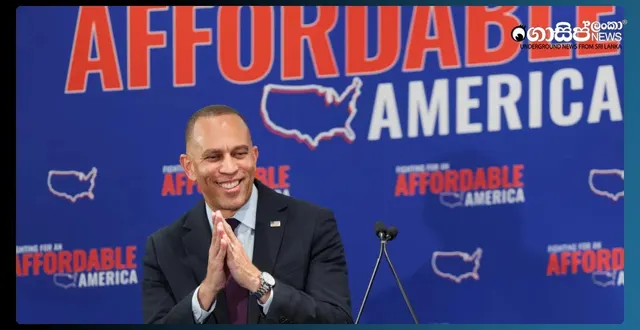
Rewriting the 237-year history of the US House of Representatives, Hakeem Jeffries is poised to become its first Black Speaker. This historic turning point comes as the Democratic Party reclaimed control of the House in the November 3 midterm elections.
Ending four years of Republican control under Speaker Mike Johnson, Democrats are projected to secure between 220 and 244 seats, comfortably crossing the 218-seat threshold required for a House majority. With Democrats also retaining control of the Senate, Chuck Schumer is set to return as Majority Leader, setting up a divided government for the final two years of President Donald Trump's term.
Delivering a victory address at the Democratic Congressional Campaign Committee's election night gathering in Washington, Jeffries declared that the great American comeback begins here. He sharply criticised the severe Medicaid cuts enacted under legislation passed on July 4, 2025, pledging to reverse them, extend Affordable Care Act subsidies, and reassert congressional authority over tariffs. He also stressed that they would address Trump's Iran policies and conduct investigations to hold corrupt actors accountable.
Jeffries, 56, has served as House Democratic Leader since January 2023. He was also the first Black lawmaker to lead a party in either chamber of the US Congress. He is expected to be elected Speaker when the new Congress convenes on January 3, 2027. Established by the Constitution, the post ranks second in the presidential line of succession after Vice President JD Vance. Democrats are scheduled to formally select their nominee during a closed-door caucus meeting in late November, with no serious challenger anticipated to emerge against him.
Born on August 4, 1970, in Brooklyn, New York, Hakeem Sekou Jeffries is the son of Laneda Jeffries, a social worker, and Marland Jeffries, a substance abuse counsellor. Raised in Crown Heights, he attended Midwood High School, earned an honours degree in political science from Binghamton University, and obtained a master's degree in public policy from Georgetown University. He later graduated with honours from New York University School of Law in 1997, clerked for a federal judge, and worked as an attorney at the Paul, Weiss law firm as well as corporate counsel for Viacom and CBS.
Jeffries represented the New York State Assembly from 2007 to 2012 before being elected to Congress in 2012 from New York's 8th congressional district, which covers areas including Bedford-Stuyvesant, Brownsville, East New York, Canarsie, and Coney Island. In 2026, he retained his seat with roughly 74.5% of the vote. Having previously served as whip and chair of the Congressional Black Caucus, he was unanimously elected Democratic Leader in the House in November 2022 following Nancy Pelosi's departure. Jeffries, who also served as a House manager in Donald Trump's first impeachment trial, is known for a calm oratorical style blending scripture and hip-hop influences. Embracing his Brooklyn roots, he once rapped under the moniker 'Kid Fresh'. Black nationalist scholar Leonard Jeffries is his uncle. He is married to Kennisandra Arciniegas, a social worker, and is the father of two sons.
Leading the House going forward will require him to balance the party's moderates against progressive newcomers. These include figures representing Democratic Socialists, such as Daryalisa Avila Chevalier, who have held back full support. Amid competing calls regarding universal healthcare, Israel policy, and more aggressive measures, his approach has centred on bread-and-butter issues like economic affordability, expanding Medicaid eligibility, raising the minimum wage, Supreme Court ethics, regulating artificial intelligence, and taxing the wealthy. Discussions over term limits for committee chairs are also underway.
Democratic leadership is expected to remain stable, with Katherine Clark as Majority Leader and Pete Aguilar as Majority Whip. On the newly minority Republican side, Mike Johnson has indicated a desire to stay on, though a leadership contest involving Steve Scalise and Jim Jordan could emerge.
The Democratic majority will hold full control over the legislative agenda, committee powers, subpoena authority, and oversight of the Trump administration and his family businesses. Nevertheless, with the presidential veto in place, bipartisan compromise will be essential to pass critical legislation such as the debt ceiling and government funding. Stating that voters rejected extremism and corruption in favour of solutions to everyday cost-of-living challenges, Jeffries noted that this shift in power marks a critical turning point defining the political trajectory of the remaining two years of Trump's presidency.